Senua AI Robotics Core
Robot physics, computed exactly from the laws of motion.
The Senua AI Robotics Core is the software a robot is developed and run on: a simulator that computes its physics exactly, a real-time layer on the robot, a mind that reads its sensors, and an instrument that measures how far any simulator is from the truth. No models. No GPU. It runs on ordinary CPUs.
How it works
We do not use models. No LLMs. No SLMs. Of any kind.
Every motion in the Robotics Core follows from its causes, computed from the laws of physics: contact and friction, joints and their limits, the servos' own torque. Nothing is trained, nothing is guessed. And the Senua AI engine that reads the robot's sensors learns the structure of each signal directly from the signal itself.
- No GPU
- No data centre
- No AI token costs, ever
- Runs on ordinary CPUs
- The same answer on Intel and ARM
In the studio, October 2026
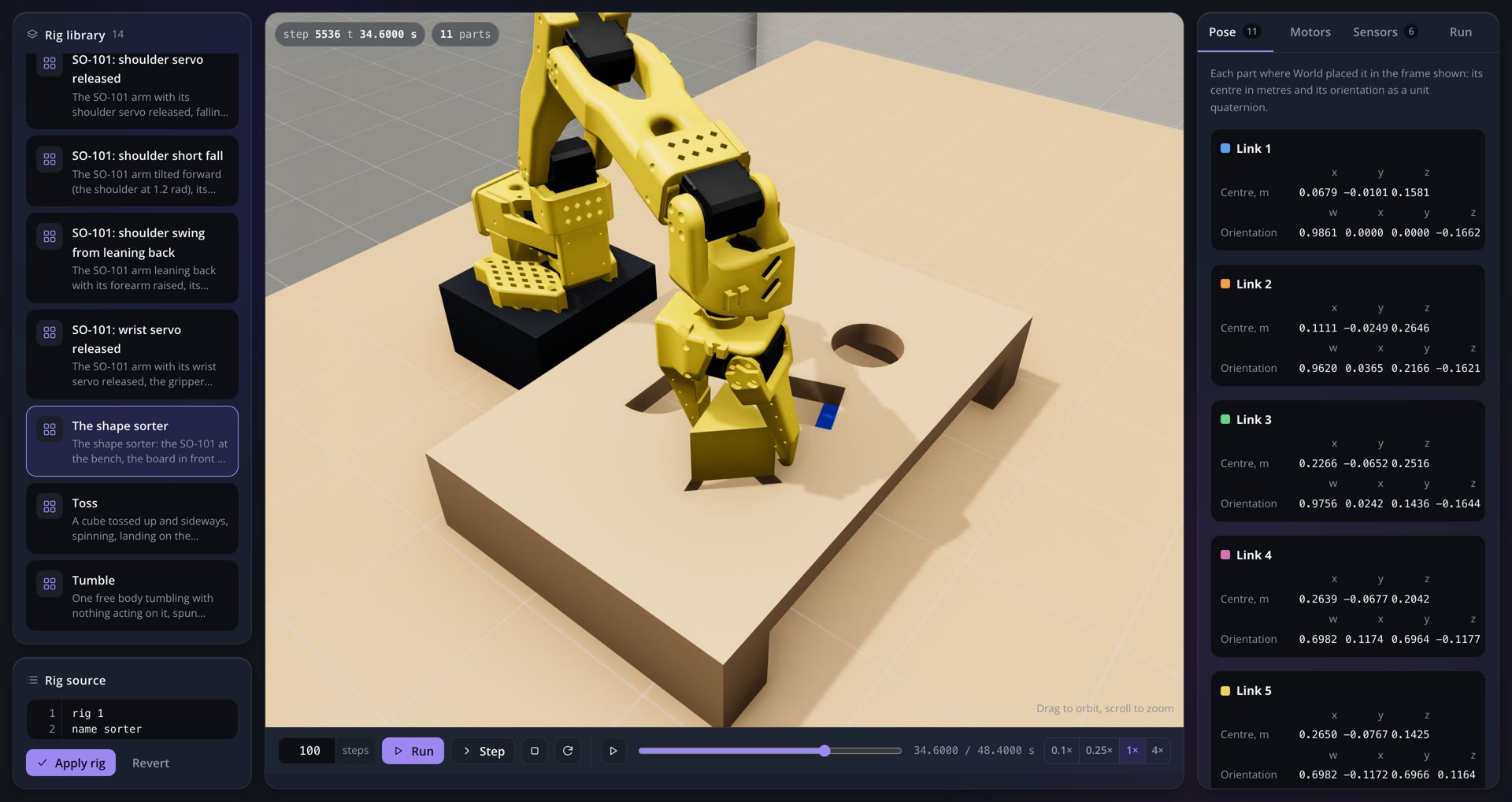
An off-the-shelf arm sorts five shapes through a board.
The SO-101, an open-hardware arm drawn from its maker's own CAD, picks each wooden shape off the bench, turns its gripper to the cutout's angle and lets it go. World computes every torque, the grasp, the carry and the fall. Then World's own measure checks every pass.
shapes through their cutouts, none touching a wall
World's run of the shape sorter, 24 October 2026
the closest any shape came to a wall, of the 3 mm each cutout allows
World's clearance measure on the same run
each shape held, carried and let go over its cutout
World's run of the shape sorter, 24 October 2026
The Robotics Core
Four parts, one language.
The code a robot is tested with in simulation is the code it runs on. Nothing is rewritten for the machine, and every part is written in Simplex, on the Senua AI engine.
World, the simulator
Contact, friction, joints, chains, grasps and servos, computed in exact integers on a grid of nanometres and nanoseconds. The same inputs give the same bytes on every machine.
WorldBody, on the robot
Device drivers, a real-time layer and a reflex loop with nothing slow in it. Disarmed by default, with force bounded before anything moves.
BodyMind, the causal engine
Reads every sensor as a stream, learns its causal states and turns each moment into a decision with a confidence. No hand-written controller and no hand-set threshold.
MindMeasure, the gap instrument
Reads two sources of the same motion and reports whether they differ, where, and by how much. It has taken apart three of the industry's physics engines, in public.
MeasureAccuracy first
Held to the laws of physics, step by step.
Simulators look alike. What separates them is whether the answer is right. World is checked against the laws it computes, on every change, before it lands.
energy drift of a swinging chain at every step size tested, where an explicit method drifted up to 13.6 billion
World's own checks, the swinging chain, 20 October 2026
test outputs byte for byte the same on Intel and on ARM
World's test gate on both processors, 24 October 2026
creep of a box held by friction below its limit
World's known-answer contact suite, 21 October 2026
Measure, in public
Three physics engines, held to the truth.
Measure held the engines of Meta, Google DeepMind and NVIDIA to the laws of physics and to the problems their own users report, traced each finding to its cause and proved every fix. Every rule, run and file is public.
Meta's SuperDex Physics
Twelve places where the engine departs from the right answer, each traced to its cause and corrected. Source: the SuperDex Physics record.
The recordGoogle DeepMind's MuJoCo
21 issues, sixteen fixed and proven, and the fixes proven together as one set. Source: the MuJoCo record.
The recordNewton
The engine of NVIDIA, Google DeepMind and Disney Research: 29 issues, 23 resolved, every fix proven in a study registered before it ran. Source: the Newton record.
The recordNext
The same run, on the real arm.
The SO-101 is on its way to the bench, and its shape sorter is being cut from the same templates World's rig is made from. The Robotics Core will send it the same servo goals over its servos' own bus and record the run the same way. Then the two are read side by side: the gap between simulation and reality, measured and shown.