

The studio
Build a robot's world, run it, and read what it feels.
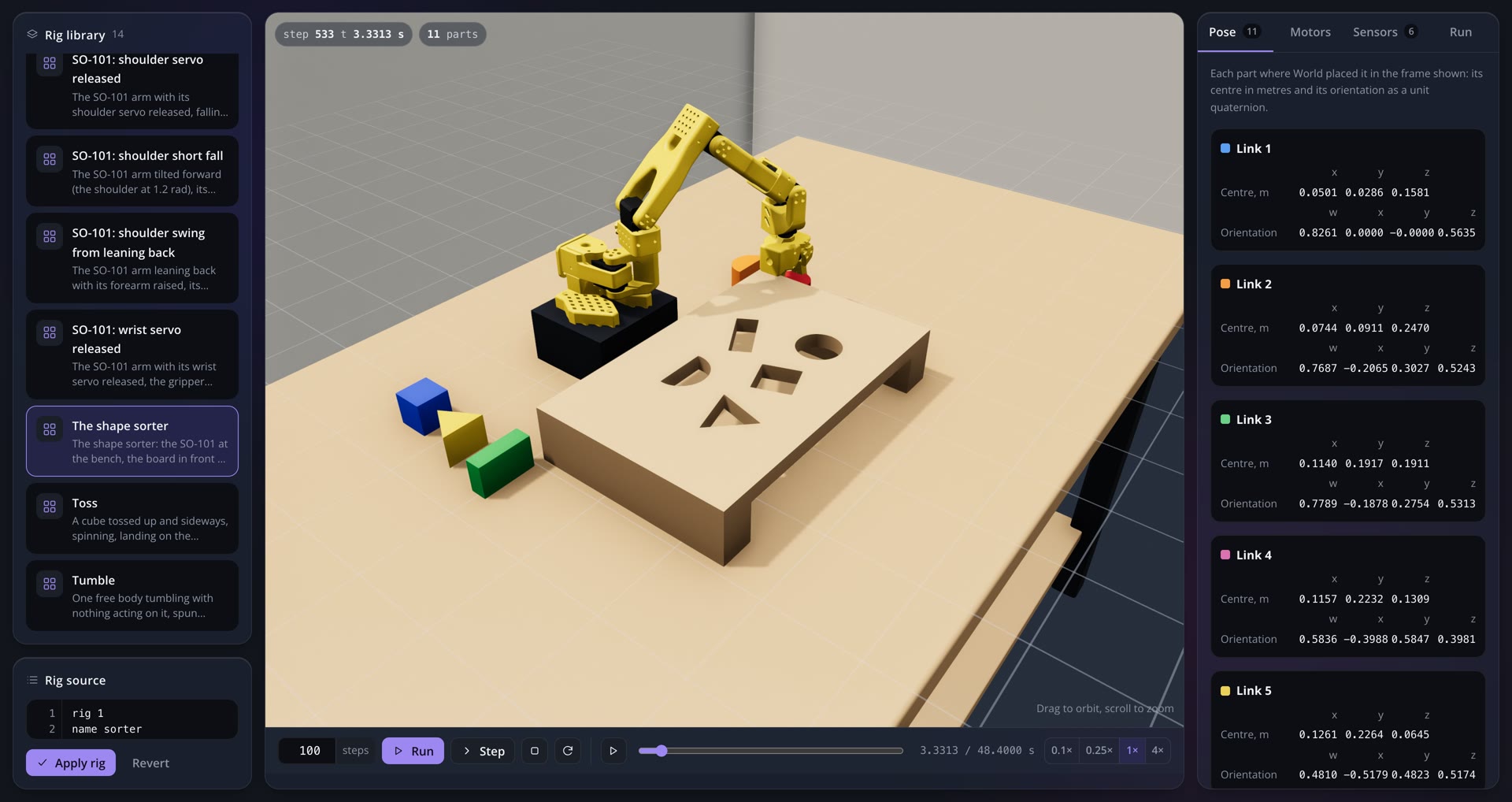
The Robotics Core studio runs in your browser. Write a rig in a few lines of text, World computes its physics, the view draws every part where World placed it, and any sensor's stream goes to Senua in one click.
What it does
Everything a robot needs, before any hardware is at risk.
A rig is a few lines of text
Bodies, links, joints, servos, sensors, the ground and gravity, each one line. Write something World cannot play and the studio names the line and the reason. It never guesses.
Real robots, from their makers' CAD
The SO-101 arm comes in with its maker's own meshes and joint description, and its rig is made from them: every link's mass, centre and limits.
Every number beside the picture
The panel beside the view shows each part's centre and orientation in the frame on screen, exactly as World computed it. Step a frame and the numbers step with it.
Devices that write the real format
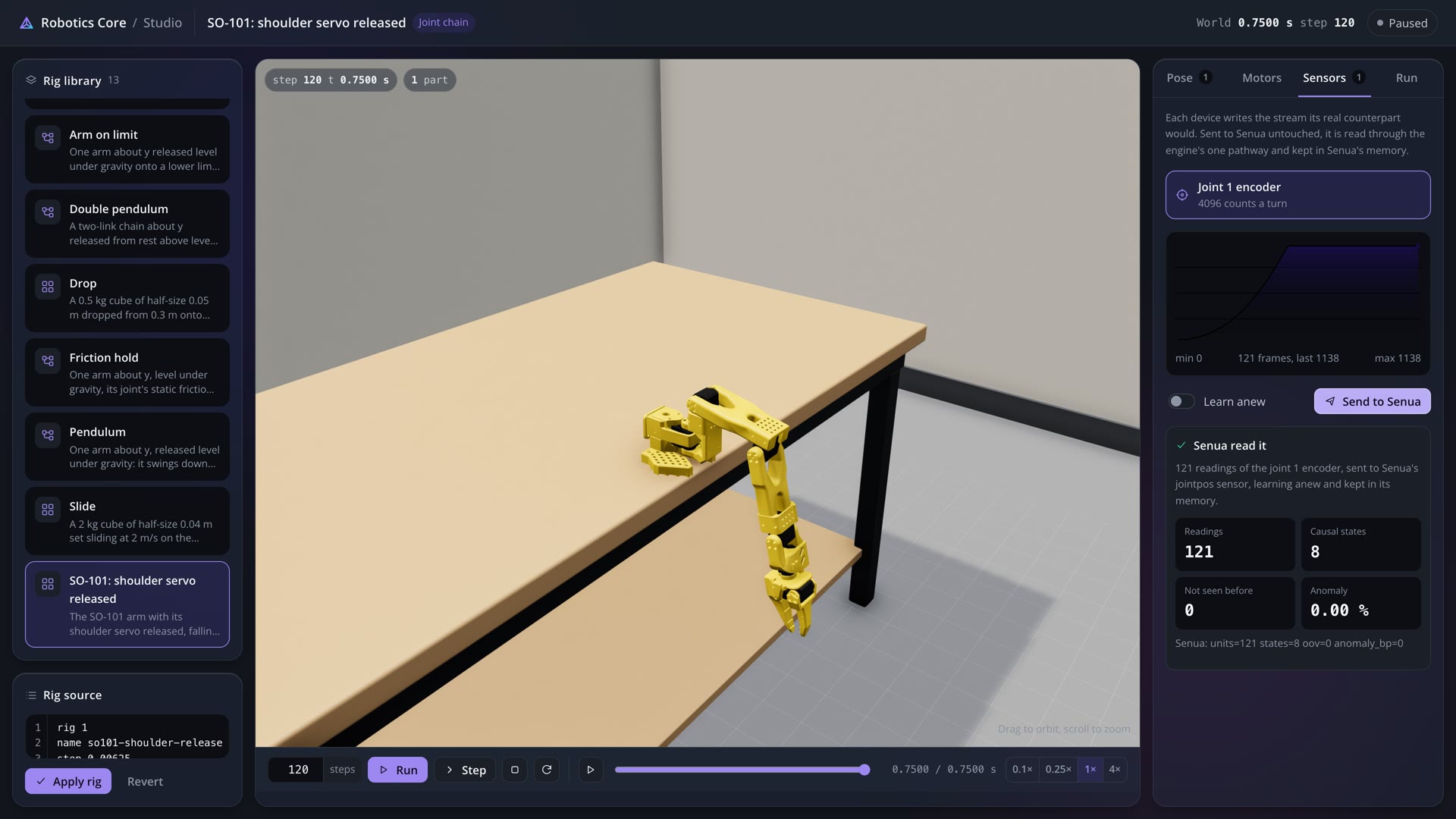
Joint encoders at 4,096 counts a turn, as the SO-101's servos read. Gyroscopes on free bodies. Motors that take commands while the run is live, from the panel or the command line.
Senua reads every stream
One click hands a device's stream to Senua, untouched. Senua learns its causal states, says what it has not seen before, and keeps it in memory to learn from.
Your host, a run for every tester
One package installs the studio on a Senua AI host. Everyone signed in gets a run of their own, and a device's stream goes from the browser to the host's own memory.
The view is drawn by Google Filament, and drawing is all it does: every pose it shows is the one World computed for that instant. There is no physics in the browser.
Mind, in the studio
Hand Senua a sensor, and it reads the stream.
Each device writes the stream its real counterpart would. Sent to Senua untouched, it is read through the engine's one pathway for every signal and kept in Senua's memory.
The showcase
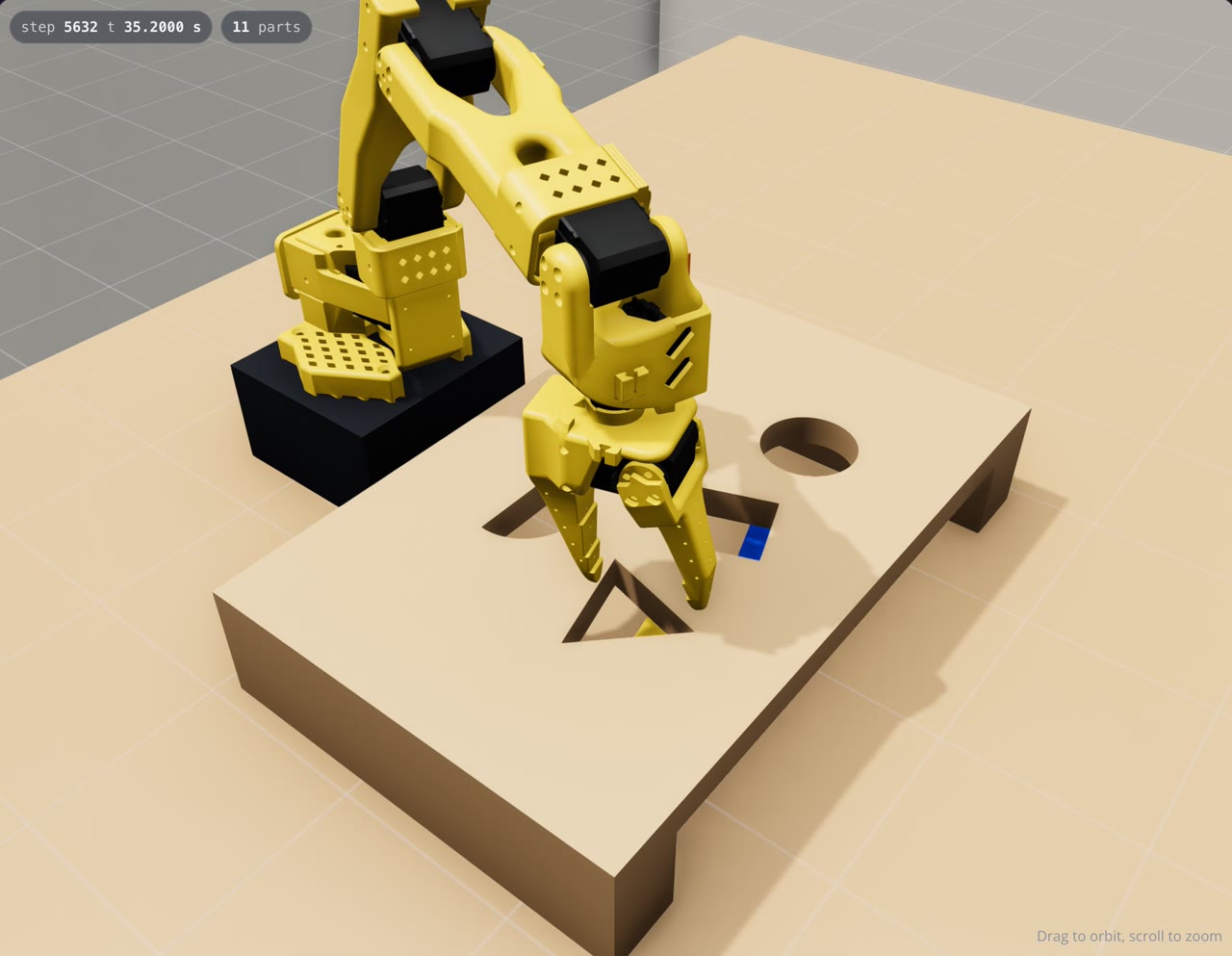
The shape sorter: pick, turn, place.
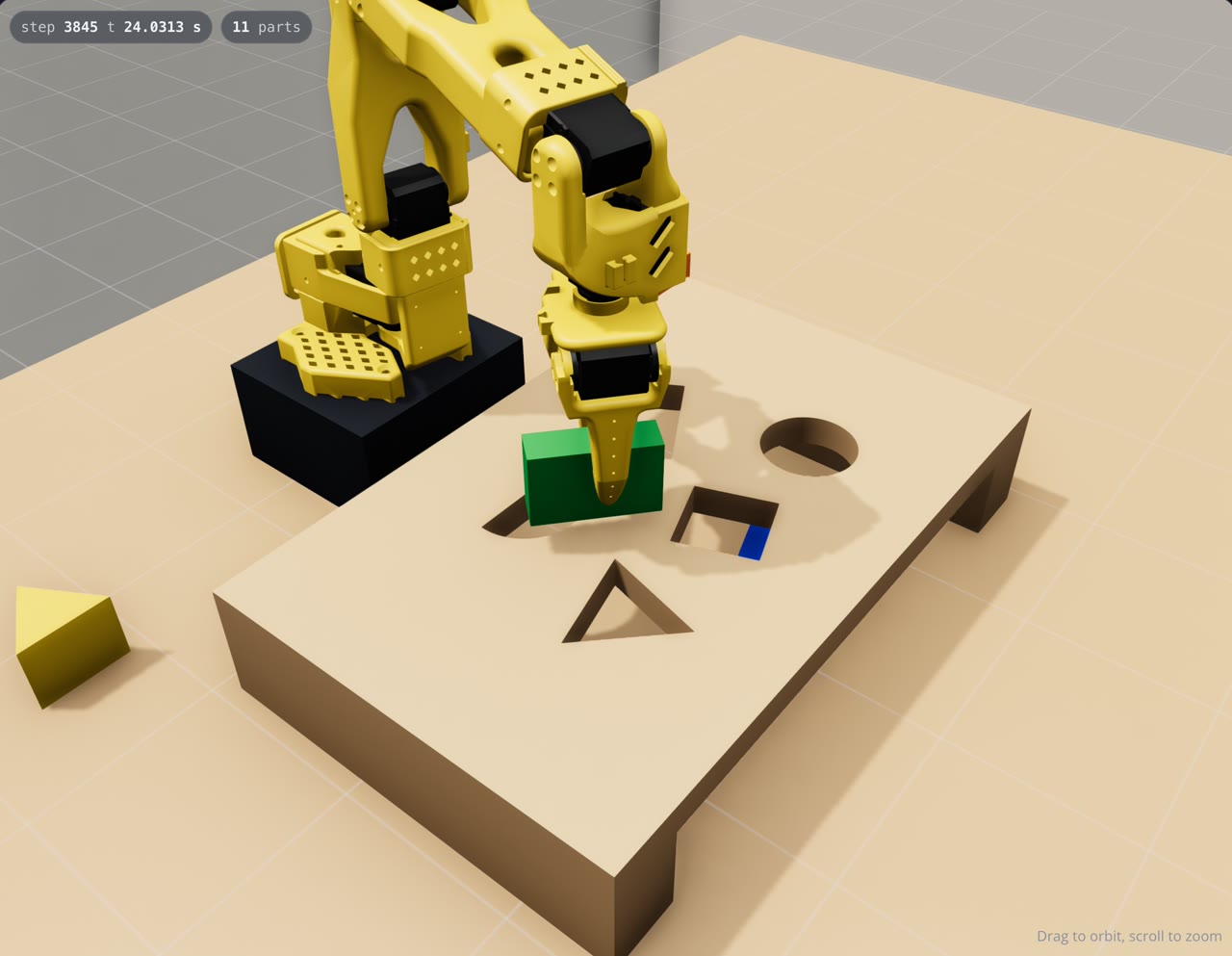
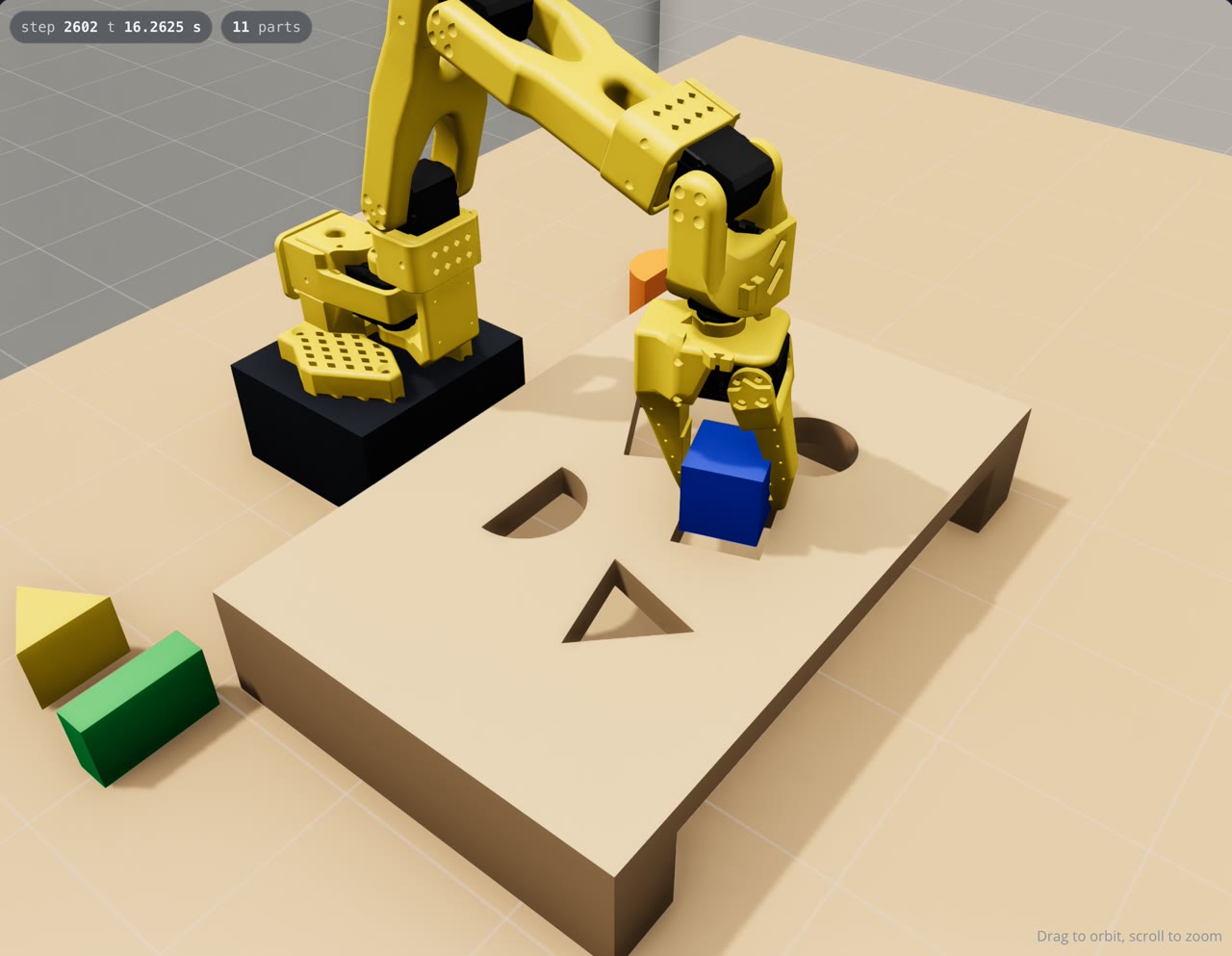
Five wooden shapes, 40 mm thick, and a board raised 50 mm with a cutout for each, 3 mm larger than its shape on every side. The arm picks each shape off the bench, turns its gripper to the cutout's angle and lets go above it. A task program writes the servos' goals. Everything after that, World computes.
Every pass, measured
The closest each shape came to a wall of its cutout, from its release until it left the board. Source: World's clearance measure on its run of the shape sorter, 24 October 2026.
| Shape | Clearance to the nearest wall | Through |
|---|---|---|
| Circle | 2.305 mm | Yes |
| Square | 2.391 mm | Yes |
| Rectangle | 1.685 mm | Yes |
| Triangle | 2.411 mm | Yes |
| Semicircle | 1.759 mm | Yes |
Five grasps, no slip, five releases, in 48.4 seconds of the arm's world: 7,744 steps of 6.25 ms, each computed from the laws of motion.
From the studio to the bench
One file defines the set, in the studio and in wood.
The shapes, the board and its cutouts are written once. The printed cutting templates, the wooden set and World's rig are all made from that one file, so the set on the bench is the set in the studio. Next, the bought SO-101 runs the same sorter from the studio, recorded the same way, and the two runs are read side by side.